
Health and Safety Policy for Garden Clearance Hainault
This document sets out the Health and Safety policy that governs our approach to garden clearance and related waste services. It applies to all employees, contractors and anyone working on behalf of the company during site clearance, removal of garden debris and general rubbish removal operations. The purpose of this policy is to ensure a consistent, safe and compliant approach across our rubbish company service area, reducing risk to people, property and the environment.Scope and objectives: the policy covers risk assessment, safe systems of work, personal protective equipment, vehicle and plant safety, waste segregation and environmental controls. It also confirms arrangements for training, reporting incidents and continuous improvement. Our aims include accident prevention, legal compliance and clear assignment of responsibilities to manage hazards associated with garden waste clearance.
Responsibilities
Senior management holds overall responsibility for setting policy and allocating resources; site supervisors and team leaders are responsible for safe operations and routine checks. All staff must follow safe working procedures and report hazards immediately. Employees are expected to act with due care, use issued PPE and participate in training. Contract operatives working in our rubbish removal and garden clearance services must be made aware of this policy and demonstrate competence before beginning work.Risk assessment and planning
Before any clearance task begins a formal risk assessment is required. This includes identification of hazardous materials (e.g., asbestos-containing materials, sharp objects, chemical containers), ground conditions, overhead hazards and public interface. Risk assessments must be recorded and kept with the job file. Control measures such as exclusion zones, traffic management and segregation of recyclables should be implemented according to the identified risks.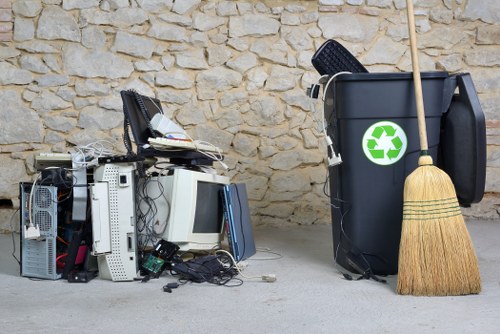
Personal Protective Equipment and tools
Appropriate PPE must be provided and worn, including gloves, eye protection, high-visibility clothing, sturdy footwear and hearing protection where needed. Tools and equipment used for garden waste clearance — shears, loppers, chainsaws, shredders and hand tools — must be maintained, inspected and used by trained personnel only. Equipment checks should be recorded at the start of each shift and defective items withdrawn from use.Manual handling and lifting controls: lifting techniques, mechanical aids and team lifts reduce musculoskeletal injury. For heavier items, use trolleys, sacks, or mechanical lifting devices. Ensure safe stacking and loading in vehicles to prevent shifting in transit. These procedures apply across our garden waste and broader rubbish removal operations to maintain safety standards throughout the service area.
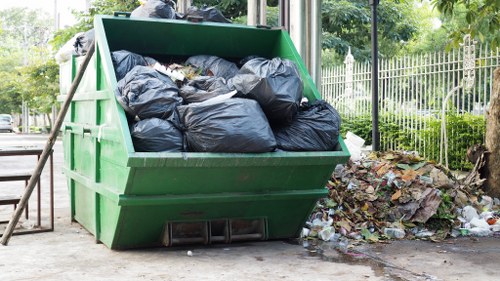
Waste segregation and disposal: all waste must be classified and segregated on site where practicable. Garden waste, green materials, timber, inert rubble and general rubbish should be separated to support recycling and reduce disposal risks. Hazardous items discovered during clearance must be isolated and handled in line with hazardous waste protocols, and external disposal contractors engaged when specialist removal is required.
 Vehicle, plant and traffic management Vehicles and plant used in garden clearance must be operated by competent persons and maintained to a high standard. Safe loading practices, use of tail lifts, secure fastenings and regular vehicle checks are mandatory. Traffic management plans are required where operations may affect public highways or pedestrian routes. Delivery and collection operations within our rubbish company service area should always consider site-specific controls to protect the public.
Training, incident reporting and review
All staff receive induction training and periodic refresher courses relevant to garden clearance and rubbish removal tasks. Training covers safe use of tools, PPE, manual handling, hazardous waste awareness and emergency procedures. Injuries, near misses and unsafe conditions must be reported immediately and investigated to prevent reoccurrence. Records of training, incidents and corrective actions will be maintained to support continual improvement.Emergency procedures and first aid: sites must have an agreed emergency plan including access to first aid, clear lines of communication and a designated emergency contact for every job. Where necessary, staff should be trained in basic first aid and familiar with procedures for dealing with major incidents, including fire, chemical exposure and serious injury. Rapid response reduces harm and demonstrates our commitment to safety.
Monitoring and compliance: the policy will be monitored through regular site inspections, audits and performance reviews. Management will ensure resources are available to meet policy requirements and that legal obligations are met. Where non-compliance is found, timely corrective actions will be implemented and lessons learned shared across teams operating in the rubbish removal and garden clearance service area.
Review and continual improvement: this Health and Safety policy will be reviewed periodically and updated in response to incidents, legislative changes or operational developments. Staff input is encouraged to improve safety outcomes. By maintaining robust procedures and promoting a safety-conscious culture, garden clearance teams can deliver efficient, sustainable and safe rubbish removal services with reduced risk to people and the environment.